How It Works
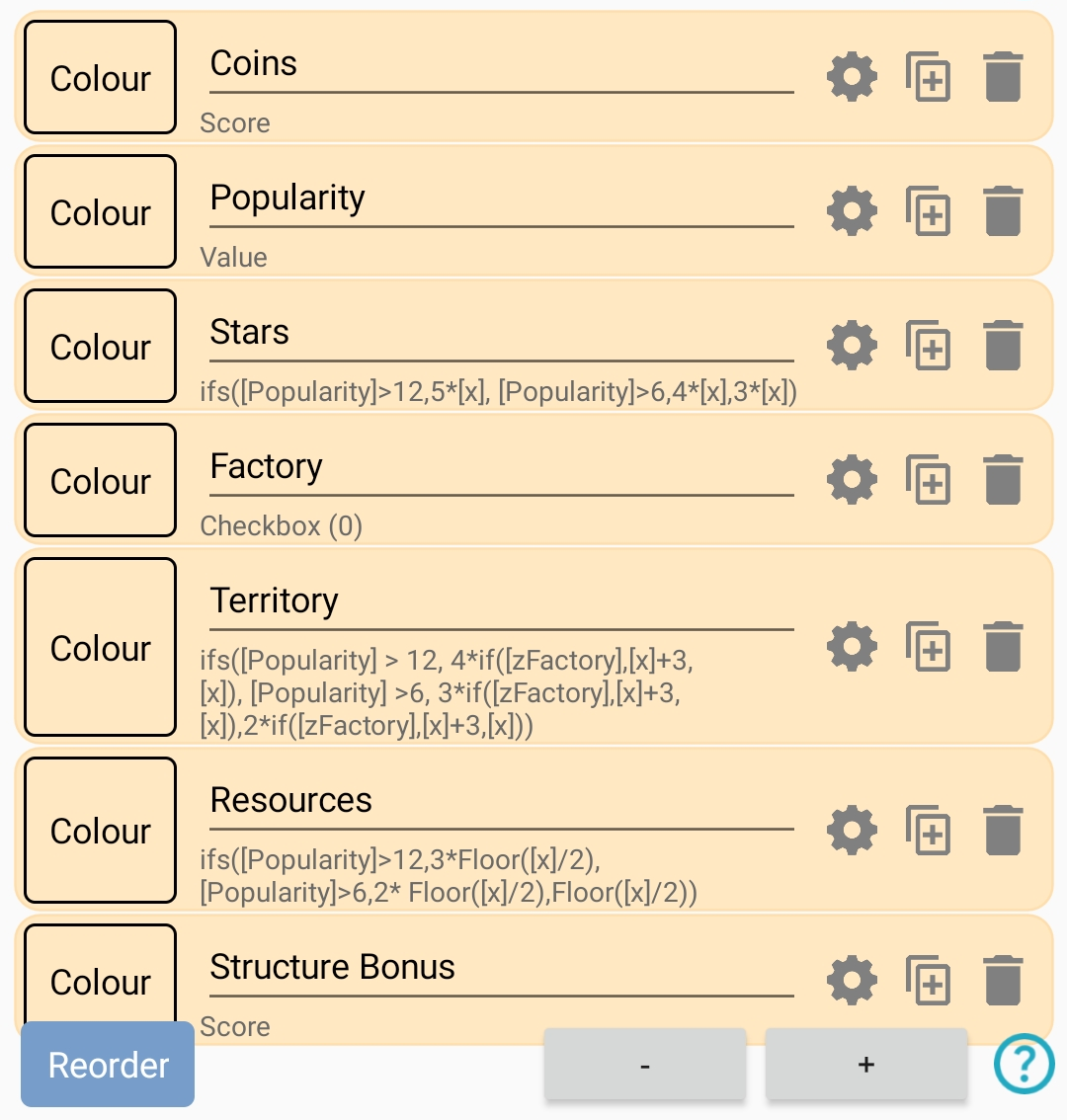
Define an equation which can use variables. Variables must always be between square brackets, but are not case-sensitive.
There are some built-in variables that can be used in any complex round:
[x] returns the value entered into this round.
[p] returns the player count.
[win] returns true if the player or co-op victory is true
In addition, you can reference any other round by putting that round's name in square brackets. For example, if you have a round named Rnd1, you can reference it with [Rnd1].
[Round] returns the score from that round (or text for text round).
[zRound] returns true or false for rounds with checkboxes for if they are checked or not.
Player rounds can reference global rounds, but global rounds cannot reference player rounds.
Rounds without a value set will be treated as zero.
Quite complex calulcations can be created using basic arithmetic as well as conditional statements and built-in functions.
Visit this link for more details about included functions. https://ncalc.github.io/ncalc/articles/language/functions.html
Examples
Derived score
Input: [x] * [Rnd1]
Result: Will multiply the value entered into this round with the score from Rnd1
Penalty rule
Input: [Victory] - [Penalty]
Result: Subtracts penalties from victory points.
Conditional rule
Input: ifs[zRnd1], 10, 5)
Result: Applies 10 points if the checkbox for zRnd1 is checked, otherwise 5 points.
Conditional rule 2
Input: ifs[Stars] > 3, 5, 0)
Result: Applies 5 points if the value of Stars is greater than 3, otherwise 0 points.
7 Wonders Science Calculator
Input: pow([compasses],2) + pow([gears],2) + pow([tablets],2) + (min([compasses],min( [gears], [tablets])) * 7)
Result: Calculates the score for the 7 Wonders Science cards. 7 points for set of each symbol plus the sum of the squares of each symbol (1, 4, 9 etc for each of the same symbol).
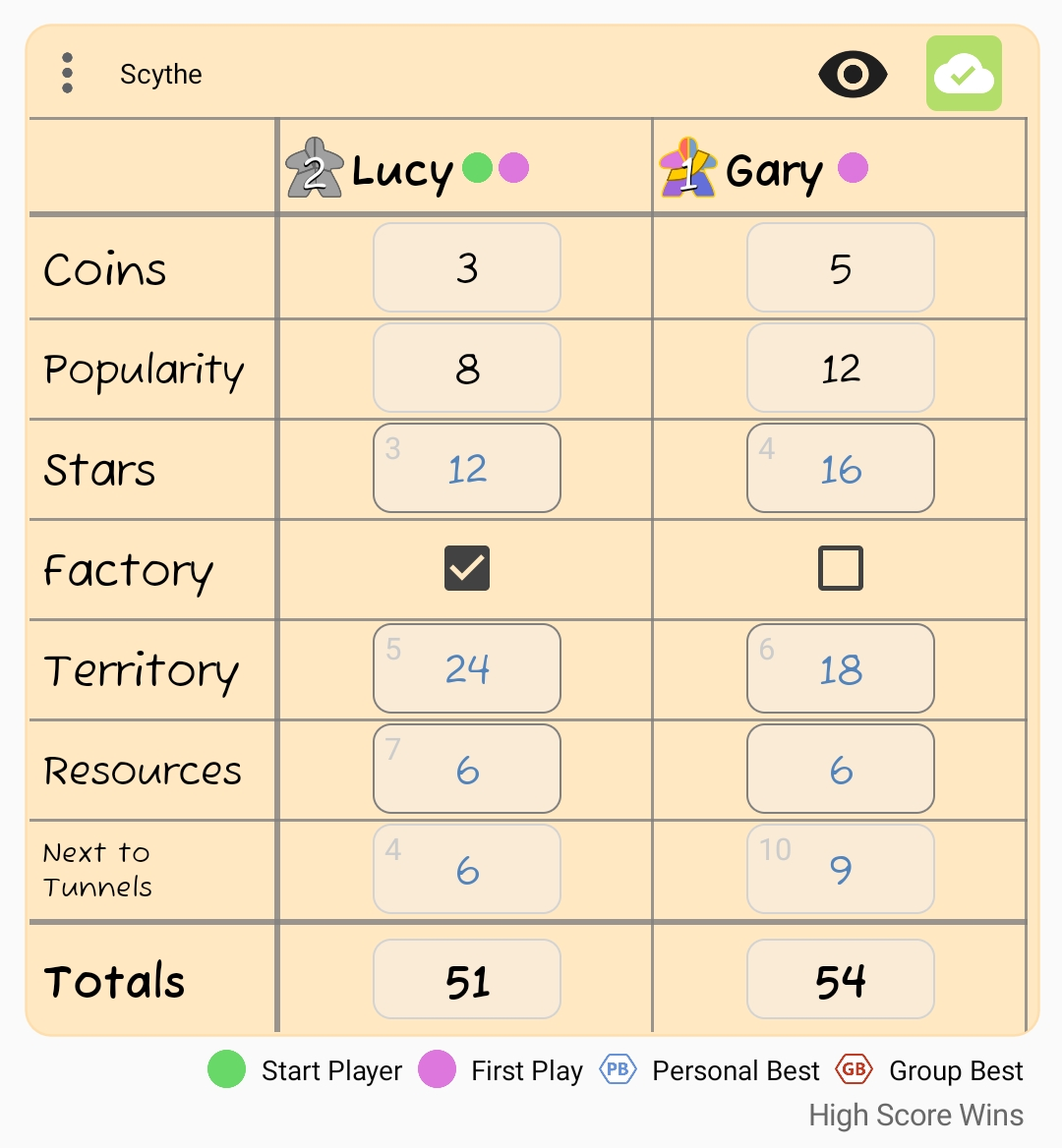
Screenshots